The Only Factor
Twentieth Sunday in Ordinary Time
Pseudo Missioner
8/16/20266 min read


My dear brothers and sisters, peace be with you. The Gospel for today was one of the most difficult ones that I had encountered when I joined the Catholic Church almost 15 years ago. To hear Jesus say, “I was sent only to the lost sheep of the house of Israel.”, and that “It is not right to take the food of the children and throw it to the dogs.” really hurt me. It was especially hurtful because I come from a family of mixed religions.
Back in those initial days of being a Catholic, Jesus was my hope for a life of fullness, the words that Jesus spoke disturbed me because it presented a Jesus who seemed to be racist, discriminated those who were not of the house of Israel, and to makes things worse, He use derogatory language, implying that those not of the House of Israel, like the Canaanite woman, are not even humans, but dogs, not fit to be at the table of the Lord.
In this episode, the idea of the “Chosen People” featured strongly in Jesus’ responses to the Canaanite lady, why did he do that? Did Jesus really believe what he said? Does Jesus discriminate some of us because of our nationality, race or religion?
Actually, the words of Jesus continue to be misused in our present time but in different ways. I remember when I was in Bolivia, teaching in an afterschool program, a young child asked me, “Is it true that all Catholics go to hell?” I was surprised to hear this from a child and asked her who told her that, and she shared that it was someone from another Christian church. Reflecting on what she shared, I recalled how the churches used to condemn each other’s teachings and how even the Catholic Church proclaimed that there is no salvation outside the Church.
Then there were the days that my family and I had to deal with my identity as an adult convert. When I was at a discernment even organized by my Archdiocese, I shared openly that I am an adult convert and that my family were not Catholics. During one of the evenings when we were free to talking to each other, one of the prospects like me, came to me and said straight to my face, “Your parents are non-Catholics, and you cannot even convince them to convert, how can you be a priest if you cannot even inspire them?”
Then, much later in my formation, after my presentation of my life history, one of my fellow seminarians, said to a group of cradle Catholic seminarians, “He is not even a pure Catholic, why does He think he is fit to be a Catholic priest?”
My brothers and sisters, there are many other stories that I can share about me or my family being discriminated by other Christians, Catholics, and people of various religions, and I think many of you can related to that. I think it becomes especially real when you live here in Taiwan because we live in a multi-cultural, multi-religion setting.
Such experiences hurt us, they hurt us because they attack what we value most, they attack our fundamental beliefs of who we believe we are in the eyes of God. It causes us to pause during different moments in our lives and wonder, “Does God also think that way? Am I not a pure Catholic? Am I not good enough? Am I not worthy?”
My brothers and sisters, if you have ever asked these questions during different moments in your life, I assure that the God we worship will never think lowly of any of us. The words that Jesus used in the scriptures today that sound so harsh and hurtful, were not meant to be taken literally. The evangelist Matthew, recorded this skillful way of Jesus teaching the people. Jesus knew that in order for His message to be heard by the Jews, he needed them to listen to him. If he had outrightly accepted the request of the Canaanite woman, none of the Jews would have stayed and listened to him, because that was not what a Jew during those days would do. To the Jews during those days, they are the chosen people of God and the rest of the world are not. Some of them felt a superiority over other because they grew up in a world emphasizing they are God’s chosen race. This so-called preferential option of God, created segregation, created class systems, created the insiders and the outliers… and such thinking is not of God.
Jesus wanted to teach the people that God’s love is inclusive and that God’s love us unconditional. But in order for the Jews to listen, he spoke the words that reflected their belief, He said those words so that the Jews would come closer and see what Jesus would do to the unworthy Canaanite woman who dared to approach a holy person of the Jewish tradition.
But the Canaanite woman who had heard of what Jesus could do, astutely pointed Jesus as the Son of David and the Lord, her pleading, “Please, Lord, for even the dogs eat the scraps that fall from the table of their masters.” revealed how well she understood the love of God, that it was unconditional, that it is abundant and plentiful, and that it will overflow to fill those who least expect it. Her words provided the materials that Jesus needed to teach the Jews the lesson He prepared. The faith of the Canaanite woman allowed Jesus to remind the Jews, it was never about the race, nationality, religion, class, it was all about faith.
And this is not a new teaching that Jesus was bringing. If we look at the first reading, the Lord said to Isaiah,
“The foreigners who join themselves to the LORD,
ministering to him,
loving the name of the LORD,
and becoming his servants—
all who keep the sabbath free from profanation
and hold to my covenant,
them I will bring to my holy mountain
and make joyful in my house of prayer;
their burnt offerings and sacrifices
will be acceptable on my altar,
for my house shall be called
a house of prayer for all peoples.”
These words made clear that God’s love was never limited to a specific group of people. Even the responsorial psalm supported that, “O God, let all the nations praise you!”
So may your way be known upon earth;
among all nations, your salvation.
May the nations be glad and exult
because you rule the peoples in equity;
the nations on the earth you guide.
May the peoples praise you, O God;
may all the peoples praise you!
Yes, the Jews were chosen by God to be His holy people, but it was not just a status, it was a responsibility. God chose them to be “Holy”, and in Hebrew, that meant to be set apart, to be different acting in the way of the Lord, so that they could inspire and guide those who have been led astray back to God. And this is because all of creation, every people, every nation, every person, is of God, because God is the creator of all things. And God’s love unites, it bonds all together, because God’s love is unconditional and inclusive.
St Paul says it well when he explained his mission to the Gentiles, saying that even when he is working directly with them, the Gentiles, his mission includes people of his own race… that even though to him, in his mission to the Gentiles, his chosen ones, it is in hope that it will awaken in his own people reconciliation with God and acceptance of God’s infinite mercy.
My brothers and sisters, the lesson that we are given today by Mother Church is not limited to the discrimination between different denomination of churches, it isn’t limited to the discrimination between different religions, it is far more powerful that all these.
And Jesus reminds us that there are no insiders or outliers with God, there are not class systems with God. What allows us to be connected with God is our faith in God, our perseverance to continue to trust Him when things get tough, when we feel oppressed, when we are suffering the effects of the attitudes formed by societal and cultural norms. Jesus tells us, that we can learn from those whom people consider the outliers, the Canaanite woman, the dog at the side of the table… because they may be able to teach us more about God, than those dressed nicely and speak well and those who think they are in charge. Jesus turns the tables against these so called chosen ones and pours out God’s favor upon the Canaanite woman because of her great faith!
My brothers and sisters, Jesus is very clear to us that we should not create any insider circles and start to exclude those we consider to be outliers. Each of us is a loved one by God, each of us is given irrevocable gift by God and is uniquely called by God to offer something to this world.
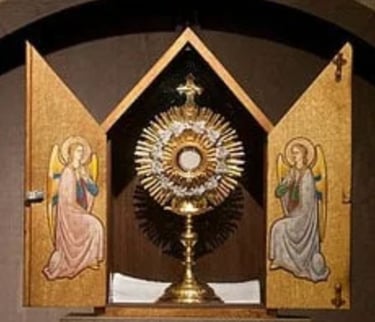
This is made known in the Eucharist, because each grain of the Eucharistic bread is brought together, fruit of the earth and work of human hands, as we pray in the liturgy to form the Body of Christ. And it is in this long, long chain of collaboration between Christians and non-Christians, Catholics and non-Catholics, people of faith and people who are still searching, everyone participates in God’s plan of salvation, and we must include, not exclude. And it is in this spirit that we continue to pray that through the Body of Christ that we will receive, that we will be more aware of God’s gifts to us and the people around us, and so work together, to make present in this world, God’s unconditional and unifying love!
Connect
Reach out anytime with your thoughts
Share your thoughts!
missioner@mysteriesfromthetabernacle.org
© 2026. All rights reserved.